Interior Design Photography for Press: What Editors Actually Want to See
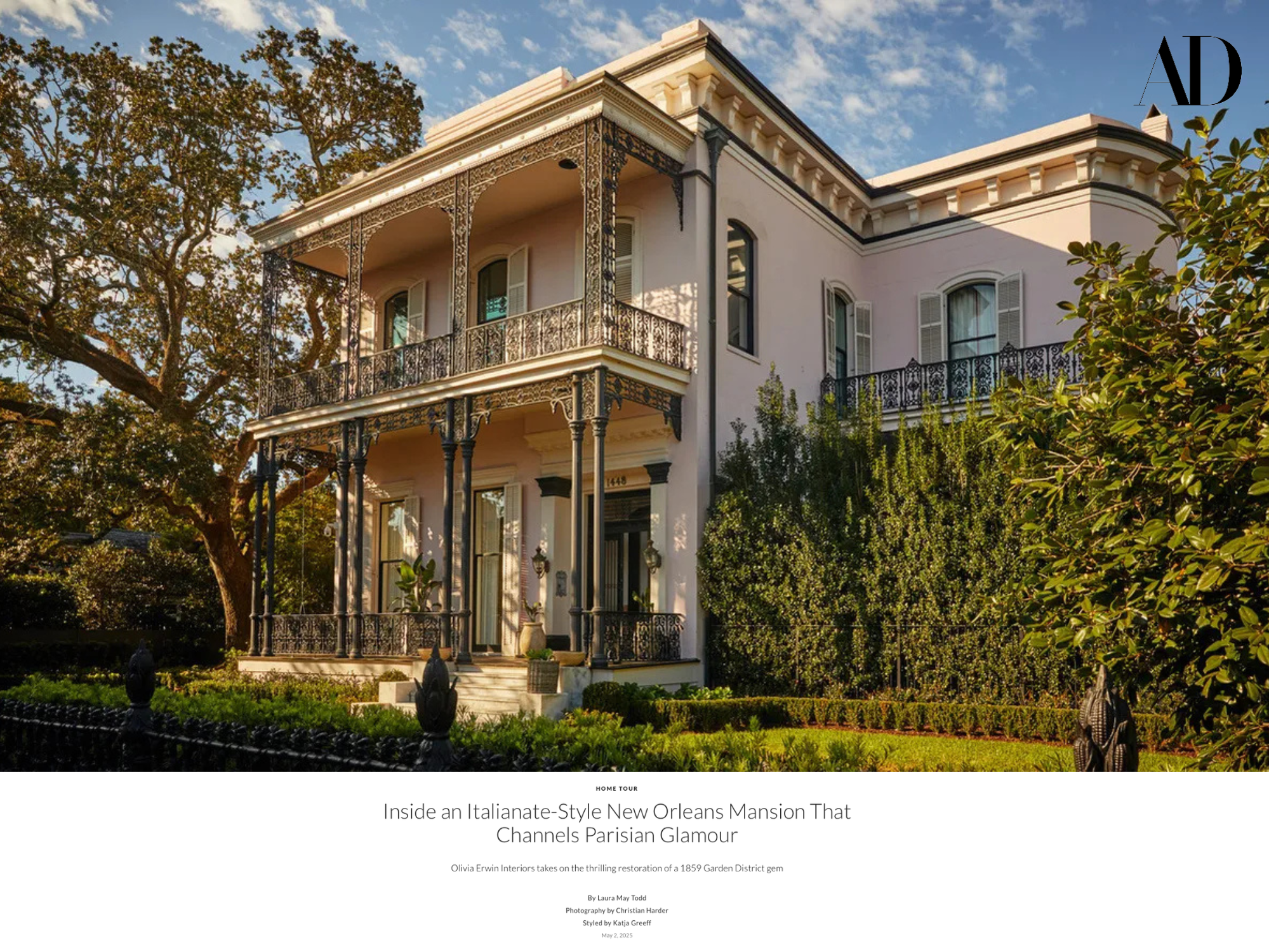
Project client Olivia Erwin featured in AD
Every month, we review countless interior design projects at The Storied Group.
And every month, we have to deliver the same difficult news to some of them: We can't move forward with this project.
Not because the design isn't good.
Because the photography isn't doing the project any favors.
It's the most common reason projects don't get placed, and the most preventable one. So let's talk about what editors actually want to see, and what's killing your chances before I even get to send a pitch.
How Many Photos You Actually Need
This is the most common issue I see: not enough images.
Designers shoot a few hero shots, love them, and call it done. More often than not, it comes down to how fast a photography shoots and the designer’s budget. Some photographers can shoot 25-30 finished images in one day, others shoot 8-10. Editors need more than that—a lot more.
For a full home tour submission, aim for 25–30 shots minimum. That means:
Overall room shots of every major space
Connecting shots, how the home flows
Vignette shots (we rarely need details for editorial, but vignettes are great to include)
Exterior shots if applicable
Enough variety for an editor to build a visual narrative across multiple layouts
Print features especially need room to breathe across a spread. Digital features need vertical options for mobile. If you only have wide horizontals, you're limiting where you can be placed.
And here's the Instagram trap: a lot of designers shoot for social first. Square crops, vertical close-ups, the perfect flat lay. Those rarely translate to press. Editorial images need to tell a room's story, not just look good as a thumbnail.
What "Lived-In and Layered" Actually Means
Editors talk about this constantly, and I think it confuses a lot of designers.
They want spaces that feel inhabited. Not staged. Not sterile. Not a room that looks like the designer left five minutes ago and took everything interesting with them.
What editors do NOT want to see:
Perfectly symmetrical pillows that no human has ever touched or worse, has the karate chop
Completely empty surfaces
Every single object perfectly centered
A kitchen with nothing on the counters (or, too much on the counters and it reads very lifestyle) This is such a balance!
Styling for camera is genuinely different from styling for life—and it's different from how you style for your clients. It's a specific skill. Which brings me to my next point.
Do You Need an Interior Stylist?
Short answer: mostly likely, yes
A good stylist who understands editorial versus residential can completely transform how a space photographs. They know how to add layers that read well on camera, how to scale objects to fill a frame, and how to add life to a space without making it look overdressed. They also know what’s at the forefront of trends and what’s been played out.
If you're going for a top-tier print placement —AD, House Beautiful, Veranda, Frederic, Elle Decor—invest in a stylist. The competition for those features is fierce, and a professionally styled shoot can make it or break it
The Conversation Most Designers Skip: Usage Rights
This one is critical and almost no one talks about it.
Before you book your photographer, you need to underhand their license fees. All photographers retain the rights to their images even when you pay for the shoot. They will then charge additional licensing fees for editorial usage—sometimes thousands of dollars—that weren’t part of the shoot quote. Most media outlets (especially for print and major digital home tours) will have a small budget to license images, but you need to know what happens if they don’t. Or if the budget is smaller than their fee. Does that mean you have to pay it? Does that mean the photos can’t run?
I've seen designers lose placement opportunities because this conversation never happened upfront. It almost happened recently for one of our project placement clients with House Beautiful. The photographer has a new agent and the agent quoted way beyond what the magazine was willing to pay. They pulled the feature. The photographer, thankfully, is wonderful to work with and sorted it out with the magazine, but it almost cost this designer press and certainly caused us all a lot of stress!
Don't find out after you've gotten an editor excited about your project that you can't actually hand over the images.
Negotiate and understand usage rights before the shoot. Always.
A Big Mistake: Mixed Lighting
We are not getting many projects these days submitted with mixed lighting, but if you are new to the game, let me shout it from the rooftops:
Turn. Off. The. Lamps.
Mixed lighting is when more than one light source appears in a photograph. In interior photography, it almost always happens when a designer leaves table lamps, pendants, or recessed lighting on—even when there's beautiful natural light coming through the windows.
The result? A yellowish tint that washes over everything. It makes spaces look smaller, colors look off, and most importantly, it signals to an editor that the shoot wasn't done with press in mind.
Here's the thing designers always tell me: "But I wanted to show the lighting fixtures."
I get it. You picked gorgeous fixtures. You want them to be seen.
But editors aren't looking at your fixtures. They're looking at the overall image quality. And mixed lighting, no matter how beautiful those pendants are, usually reads as amateur.
The rule is simple: natural light only, whenever possible. Pick the time of day when each room gets its best light. Shoot then. Turn everything else off.
Of course, rules were made to be broken, and there is a trend happening now where really technical photographers are shooting some rooms with lighting (usually sconces) glowing. It generally happens in post. I’ve had magazines question it and I’ve had magazines as big as AD run them no problem. Er on the side of caution here. Everyone involved needs to really know what they’re doing to get this right.
The Bottom Line
No publicist, no matter how good their editor relationships are, can place a project with weak photography. It's the one thing I can't fix on the back end.
But the good news is it's entirely within your control before the shoot ever happens.
If you're not sure whether your project is ready for press—or you want expert eyes on your images before you submit—that's exactly what our Photo Shoot Prep service is for. We walk you through what editors are looking for before you spend a dollar on PR.
Already have a beautifully photographed project sitting in a folder somewhere? Let's talk. A Design Well-Placed is a flat-rate service to get one project placed in one top national outlet —with a 99% placement rate.
Your work deserves to be seen. Let's make sure the images make that possible!